 |
Raymond Arbin Matzke (I24129)
Hit Count:  
|
|
||||||||||||||
|
|
||||||||||||||||

Personal Facts and Details
  Events of close relatives Events of close relatives | |
| Birth | 2 November 1920  24 24 21 Juda, Green Cty Wi 21 Juda, Green Cty Wi |
| Death | 1 December 1942 (Age 22) Buna, New Guinea |
| Burial | after 1948 Manila American Cemetery Plot L Row 2 Grave 66 |
| Universal Identifier | B9122E894222964C8AD08C09C513F0B43383 |
| Last Change | 3 December 2006 - 01:24:42 Last changed by: dcoplien |
Notes
 Note |
enlisted 15 Oct 1940 Name: Raymond E Matzke (Although his true middle name is Arbin, he used the Americanized ' 'Ervin' ' Inducted From: Wisconsin Rank: Private First Class Combat Organization: 128th Infantry 32nd Division Death Date: Dec 01 1942 Monument: Fort William Mckinley, Manila, the Philippines Last Known Status: Buried U.S. Awards: Purple Heart Medal Plot L Row 2 Grave 66 Service # 20650626 died in the Papuan Campaign - The Battle of Buna Ray was originally buried in a temp. grave in or near Buna, New Guinea. Work on the cemetery began in 1948 and it was formally dedicated in 1960, ammost 20 years after Ray had died. It is not known when his body was sent to the Philippines for final burial. Plot L is furthest to the back of the cemetery so I am assuming he was one of the last to be transferred to his final resting place. --- The World War II Manila American Cemetery and Memorial is located about six miles southeast of Manila, Republic of the Philippines within the limits of Fort Bonifacio, the former U.S. Army Fort William McKinley. It can be reached easily from the city by taxicab. The cemetery, one hundred and fifty-two acres in extent, is on a prominent plateau, visible at a distance from the east, south and west. It contains the largest number of graves of our military Dead of World War II, a total of 17,206, most of whom gave their lives in the operations in New Guinea and the Philippines. The headstones are aligned in eleven plots forming a generally circular pattern, set among masses of a wide variety of tropical trees and shrubbery. The chapel, a tall stone structure enriched with sculpture and mosaic, stands near the center of the cemetery. In front of it on a wide terrace are two large hemicycles with rooms at each end. Twenty-five large mosaic maps in these four rooms recall the achievements of the American Armed Forces in the Pacific, China, India and Burma. On rectangular Trani limestone piers within the hemicycles are inscribed the names of 36,285 of the Missing who gave their lives in the service of America and who rest in unknown graves. Carved in the floors are the seals of the American states and its territories. From the memorial and other points within the cemetery there are impressive views over the lowlands to Laguna de Bay and towards the distant mountains. The cemetery is open daily to the public from 9:00 am to 5:00 pm except December 25 and January 1. It is open on host country holidays. When the cemetery is open to the public, a staff member is on duty in the Visitors’ Building to answer questions and escort relatives to grave and memorial sites. --- Company: Nickname: Dixie Division 121st, 122nd, 123rd, 124th Infantry (Inf.) ... Thirty-second, 32nd Division (Wisconsin and Michigan National Guard) In August of 1940, Congress passed the legislation necessary to order National Guard units into active Federal Service during peacetime. The National Guard troops could not be required to serve for more than 12 months or outside of the Western Hemisphere. All 18 existing National Guard divisions, plus countless, smaller, non-divisional units, would be called up in the months that followed; the 32nd Division was among the first. The National Guard of the United States was activated in 20 increments between 16 Sept. 1940 and 23 June 1941. The 32nd Division was part of the second increment. On 15 October 1940, the 32nd Division (consisting of National Guard units from Michigan and Wisconsin) was called to Active Duty. The Division was commanded by Major General Irving J. Fish and had a strength of approximately 11,600 soldiers. Like almost all units in the National Guard, and even the Regular Army, at this time, the 32nd Division was not at full strength and did not have all of the equipment it was authorized. When the Division was called up, it was basically the same “square” division that it was during World War I. It was centered around the 125th and 126th Infantry Regiments of the 63rd Infantry Brigade from Michigan and the 127th and 128th Infantry Regiments of the 64th Infantry Brigade from Wisconsin. The 32nd Division's 57th Field Artillery Brigade was comprised of the 120th, the 121st and the 126th Artillery Regiments of the Wisconsin National Guard. The 119th Field Artillery Regiment of the Michigan National Guard had recently been detached from the 32nd Division and assigned to the 72nd Field Artillery Brigade, headquartered in Michigan. The 72nd FA Brigade included the 182nd FA, 177th FA, and 119th FA, all Michigan National Guard. The 126th FA, which took the place of the 119th FA in the 57th FA Brigade, had recently been converted from the 105th Cavalry Regiment of the Wisconsin National Guard. Some of the major unit commanders at this time included: 63rd Infantry Brigade - Brigadier General Thomas Colladay 125th Infantry Regiment - Colonel Matthias A. Weisenhoefer 126th Infantry Regiment - Colonel William Haze 64th Infantry Brigade - Brigadier General Paul B. Clemens 127th Infantry Regiment - Colonel Forrest H. Himes 128th Infantry Regiment - Colonel William A. Holden 57th Field Artillery Brigade - Brigadier General William S. Wood 120th Field Artillery Regiment - Colonel Jim Dan Hill 121st Field Artillery Regiment - Colonel Waldemar F. Breidster 126th Field Artillery Regiment - Colonel Frederick C. T. John On 20 October LTC J. Tracy Hale Jr. succeeded COL Himes as commander 127th Inf. In October 1940, the Division went to Camp Beauregard, Louisiana. The living conditions for the soldiers at Camp Beauregard were not the best, so some soldiers unaffectionately nicknamed it 'Camp Disregard.' The poor living conditions were partly the result of the fact that the camp was designed to accommodate one regiment, but the entire 32nd Division was sent there anyway. On 16 November 1940, the 32nd Division Tank Company of Janesville, Wisconsin (informally known as the Janesville Tank Company), which had been detached from the 32nd Division, entered Federal service with a strength of 114 officers and men. The unit's name would be changed to Company A, 192nd Tank Battalion, 1st Armored Division. On 27 November, Company A, 192nd Tank Battalion left Janesville in a convoy of trucks bound for Fort Knox, Kentucky. At Fort Knox, new M-3 light tanks were issued along with other vehicles and equipment. In February of 1941, the 32nd Division moved to Camp Livingston, Louisiana. On 12 August 1941, congress narrowly passed legislation that would allow the Federal service of the National Guard to be extended from 12 to 18 months, and would permit the National Guard to serve outside the Western Hemisphere. In August and September of 1941, the 32nd Division was participating, in the words of then COL Jim D. Hill, CO of the 120th FA Regiment, ' 'in a series of the most grandiose field exercises and full maneuvers ever staged any time, anywhere, before or since, by American troops. (430)' ' These exercises were collectively referred to as the Louisiana Maneuvers. They started out pitting division against division, then built up to corps against corps, and culminated in the grand finale of Lieutenant General Walter Krueger's Third Army taking the offensive against Lieutenant General Ben Lear's Second Army. ' 'The Great Maneuvers' ' ' 'Lear's Second Army (Red) Order of Battle included 3 'square' Infantry Divisions (Guard), 2 'triangular' Infantry Divisions, two Armored and one Cavalry [horse] division. Krueger's Third Army (Blue) consisted of 8 'square' Infantry Divisions (Guard), two 'triangular' Infantry Divisions, one Tank Group of only 60 light tanks, 3 Anti-Tank Battalions, one Cavalry [horse] Division and one Cavalry [horse] Brigade. Each Army Commander had 300 Air Corps planes at his disposal. A company of paratroopers was present and operational for the first time in American history. Note that Lear was comparatively light and nimble with a tremendous preponderance in armor and enjoyed all the advantages inherent in being on the defense in most difficult terrain. The opposing Third Army was heavy with 330,000 officers and men, weak on proportional motor vehicles and short on Armor and modernity of Divisional organization and equipment. ' 'Initial deployment for Krueger's Blues, with Headquarters at Lake Charles, was from Beaumont, Texas to Bayou Teche, Louisiana. Lear's Red Second Army initially was deployed North and East of the Red River from Alexandria Northwesterly to Shreveport and Caddo Lake on the Texas border. The river line and its terrain were unfavorable to tank tactics, hence Lear with some logic crossed the river on a wide front for a strong thrust forward to seize the comparatively open Peason Ridge country where the preponderance of Red Armor would be most advantageous. Red Cavalry swept wide from the Northwest flank to help foreclose the mortgage on Peason Ridge country and threaten Blue's flank from the line of the Sabine River. But the Red Cavalry did not sweep wide enough and started its flanking movement too soon. Krueger's Third Army Blue Cavalry successfully screened its own Army's open flank but also used its weight and mobility to sweep still more widely and cut deep into Red's rear North and East of Mansfield, Louisiana. While the horse cavalry war was proceeding along a line that would have met with the warm approval of both Phil Sheridan and Jeb Stuart, Blue Army's eight 'square' Guard Divisions were proving to be far less cumbersome and awkward than their obsolete organization and shortage of equipment had appeared to dictate. By temporarily 'grounding' a part of each division while all vehicles did fast shuttle movements, Blue Infantry from the Guard Divisions appeared amazingly soon in areas where time and space factors had suggested impossibility. ' 'Fast shuttle motor movements reconcentrated the 'square' Divisions for coordinated attacks upon specified objectives on their fronts. Thus each Division fought its own little war within its zone of action. Lear's Red Armor was denied the ownership of Peason Ridge with its potential for a quick defensive victory through offensive tactics. ' 'The Red Air Force was either less lucky or not so well handled. Moreover, it had been beefed up with some Navy fliers who knew not the terrain and who had no opportunity to become integrated into an instinctively reacting membership of their entire team. The 300 Blue planes were credited with more successful missions. A Blue paratroop drop of 127 officers and men, as rear area raiders and saboteurs, wrecked General Lear's Red communications. They stank up Lear's own headquarters with smoke bombs simulating complete destruction, which could have claimed Lear as a casualty. ' 'A re-e-edicu-u-lous performance!' ' General Lear sputtered in the lobby of the Camp Polk movie theater shortly prior to the grand critique. ' 'The Umpires must have partially thought likewise. The squad that pulled the stunt was ruled out because its only hostile identification was a short, thin strand of blue baby ribbon. This notwithstanding, the tide of battle forced Lear to displace his Headquarters to the rear. But it was the Cavalry that ended the long, hot, dusty campaign. With the Guard Cavalry Brigade screening and thus containing the entire Red Cavalry Division, the Blue Division of horse Cavalry swept far to westward and came in behind the Red forward positions to capture and destroy supplies. These included the Red gasoline depot. There could be but one Umpire ruling. The Red tanks and other mobile vehicles were declared immobile as their fuel tanks became empty. ' 'The maneuver war was over except for the equally grandiose critique. In it there was almost as much yapping about improperly policed, vacated bivouac areas as there was about tactics and strategy. This fell alike upon all units, Regulars and Reservists in the 'triangular' Divisions and Guardsmen in the 'square' Divisions. This situation was indeed bad throughout the maneuvers for the simple reason that the thrifty Louisiana farmers broke out their shovels and opened all the marked and dated kitchen refuse pits as fast as the sites were vacated so that their hogs could get at the garbage. Maneuver Headquarters . . . must have been aware of this, for one of the Guard Regimental Executive Officers sought a measure of remedial action by switching the markings upon otherwise properly-covered kitchen pits and the latrine trenches. There appears to have been a civilian complaint. In any event, the Guard officer received a written rebuke for having displayed an unsanitary sense of humor. (Hill 431-33)' ' About October of 1941, the Division organized a regimental combat team for the Carolina maneuvers (held later in November). It was called the 128th Regimental Combat Team but it consisted of units from the 126th, 127th and 128th Infantry, 120th Artillery, 107th Engineers, 107th Medical Regiment and other personnel from the Division. Around October, General Wood was succeeded by Brigadier General Ellerbe W. Carter as Commander of the 57th Field Artillery Brigade. Lieutenant Colonel Kenneth L. Hallenbeck became the commander of the 125th Infantry, taking the place of Colonel Wiesenhoefer. In mid-October 1941 the 192nd Tank Battalion, including the former 32nd Division Tank Company (now Co. A of the 192nd), was moved by rail to San Francisco, California. The 192nd was sent to the Philippines, where with the 194th Tank Battalion became the Provisional Tank Group on Luzon. This Tank Group included the tank companies from the National Guard Divisions from California (40th), Kentucky (38th), Illinois (33rd), Minnesota (34th), Ohio (37th) and Wisconsin (32nd). Prior to the creation of the 1st and 2nd Armored Divisions on 15 July 1940, the only armored force the US Regular Army had was an experimental Mechanized Cavalry Brigade at Fort Knox, Kentucky. Just prior to the induction of the National Guard divisions, their organic tank companies were declared non-divisional GHQ (General Headquarters) Troops. As a result, each division was stripped of its tank company and those companies now came under the direct control of the new and growing Armored Force, with then BG Adna R. Chaffee as its first Chief. When it was recognized that US forces in the Philippines needed some tanks for a more balanced force against the rising threat from Japan, BG Chaffee selected the 6 National Guard tank companies mentioned above. The tank companies of the 18 National Guard Divisions represented the oldest, most-experienced, and best-equipped armored units in being in the US. These National Guard tank companies had been training with World War I French tanks (FT-17) up until about 1940 and only now were being equipped with the M-3 light tank. On 3 December 1941 the 632nd Tank Destroyer Battalion was formed at Camp Livingston, Louisiana from personnel of the 32nd Infantry Division. When the 'square' National Guard divisions were 'triangularized', each was required to create one tank destroyer battalion from surplus units (for some reason, the 41st Division was not faced with this requirement). These battalions were numbered in the 600-series with the last 2 digits indicating the division it came from. There were 7 additional tank destroyer battalions created from the 7 brigades of National Guard corps artillery. They were numbered in the 700-series with the last 2 digits indicating the brigade it was created from. These battalions were non-divisional units, they were GHQ Troops under the control of the Armored Force (so technically they were not organic to the parent unit). However, some of these tank destroyer battalions went overseas as an attachment to the parent unit and were, for the most part, considered organic to them. Most were separated, some were redesignated to become part of an armored division, others were inactivated with their personnel absorbed into some other Armored Force unit. The 632nd Tank Destroyer Battalion was, essentially, treated as an organic unit of the 32nd Division. It went to Australia with the 32nd Division. It fought with the 32nd at Aitape and Saidor. It went into the battle for Leyte with the 1st Cavalry Division, but later joined the 32nd on Leyte. On Luzon it was initially attached to the 13th Armored Group but subsequently served with 37th, 44th and 32nd Divisions on Luzon. On 7 December 1941, in conjunction with the attack on Pearl Harbor, the Japanese began bombing the Philippines in preparation for an amphibious assault a few days later. Company A, 192nd Tank Battalion (formerly the 32nd Div. Tank Co.) fought against the Imperial Japanese Forces in many engagements and rear guard actions, and rendered assistance in covering the eventual retreat of our forces into Bataan. In January and February 1942, the 32nd Division was reorganized into a “triangular” division, centered around three infantry regiments. As a result, the 125th Infantry Regiment was detached from the Division; and the three existing artillery regiments (120th, 121st and 126th) were converted into four battalions (120th, 121st, 126th and 129th; three battalions of 105 mm howitzers and one battalion of 155 mm howitzers). The 1st Battalion of the 120th Field Artillery Regiment became the 120th Field Artillery Battalion. The 2nd Battalion of the 120th Field Artillery Regiment became the 129th Field Artillery Battalion. The 1st Battalion of the 121st Field Artillery Regiment became the 121st Field Artillery Battalion. The 1st Battalion of the 126th Field Artillery Regiment became the 126th Field Artillery Battalion. The 2nd Battalions of the 121st and 126th Field Artillery Regiments combined to become the 173rd Field Artillery Regiment, later redesignated the 173rd Field Artillery Group. The group was composed of the 173rd Field Artillery Battalion and the 985th Field Artillery Battalion (formerly 2nd Battalion, 126th FA Reg. and 2nd Battalion, 121st FA Reg., not positive which was which). The 173rd FA Group served in the European Theater and it appears that one battalion fought in Italy (Naples-Foggia, Rome-Arno, North Appenines, and Po Valley Campaigns) while the other battalion fought in northern Europe (Normandy, Northern France, Ardennes-Alsace, and Central Europe Campaigns). The engineer, medical and quartermaster regiments were also converted into battalions as part of the reorganization to a 'triangular' division. When the reorganization was complete, the 32nd Infantry Division consisted of the following units: Division Headquarters and Headquarters Company Military Police Company 126th Infantry Regiment 127th Infantry Regiment 128th Infantry Regiment Division Artillery Headquarters and Headquarters Battery 120th Field Artillery Battalion (LTC Harold A. Morgan) 121st Field Artillery Battalion (LTC Melvin L. McCreary) 126th Field Artillery Battalion (LTC Ross J. Quatsoe) 129th Field Artillery Battalion (LTC Kenneth J. Hough) 107th Engineer Battalion (Combat) (Colonel Ralph A. Loveland) 107th Medical Battalion (LTC Carl Hanna) 107th Quartermaster Battalion (MAJ Donald M. Farris) 32 Signal Company 32nd Cavalry Reconnaissance Troop 632nd Tank Destroyer Battalion (not officially organic to the Division) In January of 1942, General Fish was reassigned to other duties when he became over-age for combat command. General Fish had been associated with the 32nd Division and the Wisconsin National Guard for many years; he served on the Mexican Border with the Wisconsin National Guard in 1916 and served with the 32nd Division in World War I. In truth, the creation and enforcement of this 'over-age' policy was little more than a thinly veiled excuse to get rid of senior National Guard officers and give their desirable commands to Regular Army officers. To make a long, complicated story short, the Regular Army in 1940 was bloated with officers, especially colonels but other officer ranks as well. This excess in officers was partly caused by the fact that the strength of the Regular Army was drastically reduced after World War I; they got rid of many enlisted soldiers but kept many officers. Also, the promotion system for officers between the wars was very ineffective. Sometimes the Regular Army officers that replaced these so-called 'over-age' National Guard officers were themselves over-age or later became over-age but were not replaced when they did. Another tactic used to replace National Guard officers with Regular Army officers was to give the National Guard officers extremely rigorous physical examinations, much more thorough than those given to enlisted soldiers, junior officers or Regular Army officers. In this way they could create more vacancies for Regular Army officers by claiming that some of these National Guard officers suffered from often unnamed or nonexistent ailments. This information is not being included here to imply that these Regular Army officers were in any way undeserving or unqualified for these positions. It is only being included to point out that some National Guard officers were treated in an unjust and unprofessional manner by some in the Regular Army. On 9 February 1942, Brigadier General Edwin F. Harding took command of the Division. He was promoted to Major General on 13 February. MG Harding came to the 32nd Division from the 9th Infantry Division, where he had been assistant division commander. Before that he had been commander of the 27th Infantry Regiment (at that time the 27th Inf. was assigned to the Hawaiian Division). He had graduated from the U.S. Military Academy in 1909. He was a native of Franklin, Ohio. Brigadier General Albert W. Waldron was assigned to the Division around this time as commanding general, 32nd Division Artillery. Shortly after General Harding assumed command, the Division moved to Fort Devens, Massachusetts and began preparing to be shipped to Northern Ireland. On 25 March 1942, the Division was notified that it was being sent to Australia to help halt the Japanese advances in the Southwest Pacific and attempt to put the Japanese on the defensive. The Division boarded troop trains and headed for San Francisco. The 107th Engineers had already sailed for Europe so the 114th Engineer Combat Battalion from New England hastily took their place in the 32nd Division. The 32nd Division, along with the 41st Division, would become part of I Corps in Australia. Major General Robert L. Eichelberger, a classmate of General Harding’s at West Point, was the I Corps commander. I Corps had been scheduled to participate in Operation Torch in North Africa later in the year, until a last minute change sent it, too, to Australia. General Eichelberger had seen sudden changes of mission before (and he would see more in the future), during World War I, when scheduled to go to France, a last minute change found him as assistant chief of staff of our American Expeditionary Force in Siberia, Russia. On 9 April 1942, Bataan fell to the Japanese. All surviving members of Company A, 192nd Tank Battalion became prisoners and, along with the other American and Philippine forces who surrendered to the Japanese, participated in the infamous ' 'Death March.' ' Three years later, after the defeat of Japan, the 35 remaining men of the Janesville Tank Company were released from POW camps and returned home. The Company had 114 officers and men when it entered Federal service on 16 Nov. 1940. On 22 April, the 32nd Division sailed from San Francisco bound for Australia. Just before they left, the Division picked up some 3,000 replacements, most of these had just finished basic training (the Division was still short around 1,800 men). On 14 May 1942 the 32nd Division reached Adelaide, South Australia. It was sent to Camp Woodside (east of Adelaide) and Camp Sandy Creek (north of Adelaide). In July of 1942 the Division relocated to Camp Tamborine, near Brisbane on Australia's east coast. On 30 August, Camp Tamborine was renamed Camp Cable, in honor of Corporal Gerald Cable, a soldier in Service Company, 126th Infantry. CPL Cable was making the trip to Brisbane by boat; he was killed when the boat was torpedoed by a Japanese submarine; giving him the distinction of being the first soldier of the 32nd Division to be KIA in World War II. The 900-mile move from Adelaide to Brisbane was rather difficult. Much of the Division's equipment and personnel were shipped by railroad (some also went by sea). Each Territory in Australia had its own (different) rail gauge (gauge refers to the distance between the two rails). The trains had to stop at the border of each territory; the train was then unloaded and all the equipment and soldiers had to be loaded onto a different train that was compatible with the rail gauge in the next territory. The 32nd Division crossed the borders of four Australian Territories before it reached Brisbane. In August 1942 the 107th Engineer Battalion (Michigan National Guard and formerly part of the 32nd Div.) and the 112th Engineer Battalion (Ohio) were combined to form the 112th Engineer Regiment in Ireland. Invasion of Guadalcanal ' 'I have just returned from visiting the Marines at the front, and there is not a finer fighting organization in the world!' ' General Douglas MacArthur, US Army During the months following Pearl Harbor, the Japanese realized that the Allies did not have enough forces to protect the many islands stretching southeast from Rabaul, the main Japanese naval and air base on New Britain. Because of this, they were in no big hurry to occupy any of these islands. The Japanese commanders sent small detachments to Tulagi Harbor on 26 Apr 1942 and within weeks they had a radio station built. Less than a month later patrols were sent out to Guadalcanal to look for food as well as native laborers for the Tulagi garrison. It was at this time that they realized that an airfield could be built. The second week of July saw 3000 Japanese from different construction battalions at work on the airfield. Because the Japanese were busily building an airfield on Guadalcanal, the Americans launched the first phase of ' 'Operation Watchtower' ', to occupy the Santa Cruz Islands and recapture Tulagi and Guadalcanal. The 1st Marine Division, under the command of MajorGeneral Alexander A. Vandegrift, was given the task to carry out the invasion. D-day was set for 7 Aug 1942 despite the lack of training for this mission. General Vandegrift was not pleased that the Marines did not have enough information about the coral reef around the landing area, or the little knowledge of the interior jungle of the island. Vandegrift also felt that the Marines needed more training at amphibious landings. However, the landing was achieved on 7 Aug, as planned. The landing force involved 24 transports and cargo ships carrying 19000 Marines, screened by 54 warships, including three carriers. Marines pushed ashore, unapposed, as the landing caught the Japanese completely by surprise. Marines pressed on to achieve their first day objectives, mainly reaching the airfield. Back at the beach the main problem was the small number of men in the shore parties unloading the transports. Chaos was abound as naval personnel just dumped supplies all over the beach in no particular order. The 1st Battalion, 2nd Marines, landed on Florida Island and met with little resistance. The 1st Raider Battalion assaulting Tulagi didn't have such an easy time. Nor did the 1st Parachute Battalion at Gavutu. The Raiders ran into a heavy barrage of mortar and machine gun fire. During the 7-8 of August they beat back several major frontal attacks before the Raiders were able to clear out the caves of surviving Japanese and secure the island by dusk. When the Japanese at Rabaul learned of the landing on Guadalcanal they sent several sorties of enemy bombers to attack the transports. However, none did any damage and several planes were shot down. Despite the easy landing on the 'canal it wasn't to be so easy the rest of the operation. Especially for the US Navy. In preparation for the battle of Salvo Island on 9 Aug Vadm Gun'ichi Mikawa, commander of the 8th Fleet sent five heavy cruisers, two light cruisers, and a destroyer down the 'slot' during a daylight run. Poor communication misidentified the Jap force as two seaplane tenders. Because of this, the Allies were caught by surprise in the early morning of 9 Aug and the end result saw the Allies lose 3 American and one Australian cruisers. Other US ships were damaged or disabled, and the US carrier force was withdrawn for fear of further Japanese attacks leaving the Marines and Sailors ashore on their own. The Japanese ships suffered minor damage and withdrew before attacking the vulnerable troopships standing off Guadalcanal. On 17 Aug US Marine Raiders, led by Lt. Colonel Evans Carlson were landed on Makin Island in the Gilbert Islands by two navy subs. The 221 man force destroyed all installations, including a newly completed seaplane base, on the Japanese held island and killed all 90 gooks. Carlson's Raiders lost 30 men and 14 were wounded. The Japanese made several attempts to reinforce their own troops on Guadalcanal. The early attempts failed, however Admiral Tanaka realizing he owned the waters from dusk to dawn began sending troops via the ' 'Tokyo Express' ' after dark. On 21 Aug the Japanese launched a counterattack on Marine positions along the Tenaru River. They sent 900 Japanese Infantry against LtCol Al Pollock's 2nd Battalion, 1st Marines. The Marines had a platoon of machine guns and a 37mm gun crew. The Japs kept attempting to cross the river but were driven back. When they did get across the river and set up a machine gun it was silenced by grenades. Flanking the Japs from the Ilu was the 1st Battalion, 1st Marines commanded by Lt. Col Lenard Cresswell. Wildcats and M-3 light tanks strafed and fired on the retreating enemy. When the battle was over the Japs suffered 800 casualties. The disgraced Jap Commander Col Ichiki went off and committed suicide. Marines lost 34 dead, 75 wounded. Even though the Japanese were able to get soldiers ashore and muster an attack they were not prepared for the terrain and climate. Japanese commanders planned a very complex attack on Henderson Field. The main thrust was from the south by a force of 3000 men. The route led the soldiers thru the putrid jungle where heat and humidity slowed their advance as well as malaria, malnutrition, and dysentery. It took six days to march to their destination. It gave Colonel Merritt Edson's Raiders plenty of time to dig in, coordinate artillery support, and wait for the battle on ' 'Edson's Ridge' '. The first Japanese thrust came at 2100hrs against Edsons left flank. Two Japanese cruisers and a destroyer opened fire on the ridge. Boiling out of the jungle, the enemy soldiers attacked fearlessly into the face of rifle and machine gun fire, closing to bayonet range. They were thrown back. The Japanese came again, this time against the right flank, penetrating the Marines' positions. Again the Marines held the enemy back. They attacked one more time, only to be thrown back once again. After the third attack ended at 0230 Edson radioed Vandegrift that his Marines could hold. And they did. The enemy attacks the next night were as fierce as any man had seen. The Japanese were everywhere, fighting hand-to-hand in the Marines foxholes and gunpits and filtering past forward positions to attack from the rear. Colonel Edson appeared wherever the fighting was toughest, encouraging his men to their utmost efforts. Artillerymen from the 5th Battalion, 11th Marines, as they had done the previous night, fired their 105mm howitzers at any called target. The range grew as short as 1600 yards from tube to impact. The Japanese finally could take no more. They pulled back as dawn approached. Each of the attacks by Major General Kiyotake Kawaguchi's 35th Brigade failed with the loss of more than 600 killed. Another 600 were wounded. Edson's force lost 59 dead, 194 wounded. Another 10 were missing. Both Colonel Edson and Captain Kenneth Bailey, commanding the raiders Company C, were awarded the Medal of Honor for their heroic and inspirational actions. With Kawaguchi's failure brought crisis at Rabaul as the Japanese high command made Guadalcanal their number one priority in the South Pacific. In the meantime, on 18 Sept, General Vandegrift was finally able to secure the necessary supplies of tanks, rations, ammunition, aviation fuel, and reinforcements in the form of the 7th Marine Regiment.Vandegrift was also presented 3000 men of the 164th RCT. Also included in the new arrivals was the commander of 1st Battalion, 7th Marines, one Lt. Colonel Lewis ' 'Chesty' ' Puller. #On 7 Oct, Vandegrift launched a five-battlalion attack against the Japanese positions along the matanikau river. Lt. Colonel ' 'Chesty' ' Puller's 1st battalion, 7th Marines, surprised a large Japanese force in bivouac. He set up a defense line along a ridge, called in artillery and mortar fire down on the enemy, who were caught in a ravine. When the mortar fire drove the Japanese up the slopes of the crater, they emerged into the fields of fire from his machine guns, which cut down scores of the enemy. When the Japanese retreated back inside the crater Puller called in his deadly mortar fire which ended the Japanese threat quickly. In all, more than seven hundred Japanese were killed. General Maruyama was forced to pull back his line two miles. Enemy documents found on dead nips revealed how the Japanese felt about US Marines ' 'The Americans on this Island are not ordinary troops, but Marines, a special force recruited from jails and insane asylums for blood lust. There is no honorable death to prisoners, their arms are cut off, they are staked on this airfield, and run over by steamrollers.' ' Ooh-rah!!!! Admiral Yamamoto who was in charge of the main Japanese fleet north of the Solomons, sent a major strike force built around the battleships Kongo and Haruna whose task was the destruction of planes and equipment at Henderson field. With the addition of cruisers and destroyers, they bombarded the airstrip for two hours. They damaged or completely destroyed all of the fighters and most of the torpedo bombers. In addition, the shelling killed 60 Marines. The bombardment by Japanese artillery preceded a large troop buildup along the Matanikau river of about 20,000 Japanese. Another attack force of 7000 Japanese was marching toward the airfield from the South. This was the main force led by General Maruyama. However, the march was through very rough jungle terrain, and the heat and humidity slowed the Japanese and they were forced to leave a large number of their weapons in the jungle and the attack was postponed for two days. The Japanese Reports of the delayed assault did not reach the Japanese attacking across the Matanikau. General Sumiyoshi sent his tanks across the river ahead of the infantry. They were all destroyed by antitank guns and the infantry was once again dispersed by artillery fire. Meanwhile, Gen Maruyama had rescheduled his assault for 1700 on 24 Oct, however heavy rain turned the jungle into a swamp, broke down communications, and prevented the right flank from being in the correct position to attack. Instead of waiting, Gen. Maruyama attacked with just the left flank up Edson's Ridge. Once again ' 'Chesty' ' Puller and his 1st Battalion, 7th Marines, were waiting. When the Japanese began to cut through the barbed wire on the outer perimeter the order was given to 'open fire'. The front erupted with blazing tracer fire and over their heads the artillery shells sliced through the rainstorm. Explosions in the jungle halted Japanese columns before they could get moving, However, the enemy at the front continued to cut through the wire using grenades and getting fired upon by Marine machine guns. Japs were dying on front of Marine positions so persistently that the stacks of dead bodies had to be removed to open up the fields of fire. Colonel Puller had all his weapons firing. 37 anti-tank gun erased colums of Japanese at the edge of the jungle. There was several 50 & 30 caliber guns, two anti tank guns, 18 bars, and a 60 mortar battery. The mortar fired 600 rounds during the night until the barrel was red hot. Barrels of 105's were white hot from intense firing. Colonel Puller's battalion was down to 500 men and reinforcements were on the way in the form of the 3rd battalion of the Army's 164th Regiment. The soldiers fit in perfectly with their new M-1 rifles. The Japanese continued to attack relentlessly and was able to drive a wedge into the Marine line some 75 yards deep and 50 yards wide. Mortars fired a flurry of fire which closed the breach. A party of about 40 Japanese were discovered sleeping near the 80 milimeter mortar position. They were armed with land mines and dynamite apparently to use on the mortars that had been terrorizing their positions all night. The Japanese were wiped out. There were so many dead Japanese that bulldozers were brought in to bury the corpses in pits. While turning back every assault by the Japanese that evening more than 1400 dead Japanese were stacked in front of the Marines' lines. On 8 Nov luck ran out for Colonel 'Chesty' Puller. For the first time in his 23 year military career Puller was hit by enemy fire. Shell fragments tore into his legs and lower body. After getting back on his feet Puller was felled once more by a Japanese sniper as rounds hit him in the arm. Although he had been hit seven times with bullets and shrapnel, Puller was still in command and was able to call in an artillery attack that silenced the Japanese guns. Eventually Puller was removed to the field hospital for proper medical attention which laid up the Colonel for 8 days. On January 2, Colonel Puller left Guadalcanal for Washington DC. On 12 Nov U.S. Marines closed the Gavaga Creek pocket having killed 450 nips. On 15 Nov five Sullivan brothers were killed when the cruiser Juneau was sunk off of Guadalcanal. They had all enlisted together in Waterloo, Iowa only eleven months before. The Sullivans, a destroyer, was named in their honor in April 1943. Gen. Maruyama attempted one more futile attack against the marines on Edson's Ridge. However, as the slaughter of his men continued, even Maruyama realized it was time to retreat. It was the courage and fighting spirit of both the Marines and Army soldiers that won the Battle of Guadalcanal. Overconfidence and rigidity by Japanese commanders were two of the reasons for the collapse of the Japanese forces on Guadalcanal. The Japanese set out on a plan of attack, but there was no room for alterations to the plan. If a Japanese soldier attempted to go off and try another avenue of attack, he risk the chance of getting shot in the back by his own commanders. Surely the Japanese felt contempt for the Allies and believed that the raw courage of their infantry combined with aerial and naval superiority would assure an easy victory. However, poor reconnaissance of the jungle and terrain, launching frontal attacks with weary and out of position troops contributed to the destruction of one of the Japanese finest infantry divisions for absolutely no gain. Also it is this webmasters opinion that the Japanese hadn't experienced a good butt kicking in a long time. Thus, they didn't know how to lose. Carlson's Raiders completed a month long trek from Aola Bay to lunga Point, losing 17 Marines while killing 400 Japs. Fighting continued for the Allies on Guadalcanal into 1943 although the weary 1st Marine Division was evacuated at the end of Dec 1942 and replaced by elements of the 2nd Marine Division. In all the fighting the 1st Marine Division suffered 774 killed and 1,962 wounded. Another 5,400 suffered from malaria. Of the estimated 36,000 Japanese who fought on the 'canal more than 14,000 were killed and another 9,000 perished from disease. American infantry casualities were set at 1,600 killed and 4,300 wounded. The Japanese expended so much energy on Guadalcanal that they failed to improve their situation on New Guinea. Japanese expansion in the Pacific stopped at Guadalcanal...... #Excerpts taken from ' 'Marine: The story of Lewis 'Chesty' Puller' ' by Burke Davis Strategic Situation And Overview On The Eve Of The Papuan Campaign In the Fall of 1942 the Japanese were in control of half of the Pacific and a large portion of the Asian continent. It was felt that they were seriously considering an invasion of Australia. The U.S. Navy's victories at the Coral Sea and Midway in May and June of 1942 had improved the strategic situation somewhat. But these defeats did not deter the Japanese from continuing their two pronged offensive in the Southwest Pacific with the objective of cutting the supply line from America to Australia and New Zealand. The eastern drive through the Solomon Islands was eventually halted at Guadalcanal. The western drive was attempted in order to gain control of southeastern New Guinea, especially the Papuan capital of Port Moresby, which would put them in striking distance of Australia and would strengthen their defenses in the Southwest Pacific. The Japanese defeat during the Battle of the Coral Sea halted their effort to capture Port Moresby by sea. Undaunted, the Japanese landed troops at Buna, Gona and Sanananda on the northeast coast of Papua in July and pushed southward across the Papuan peninsula toward Port Moresby. Control of the north coast of New Guinea was also vital to future Allied strategy. Taking it from the Japanese would remove the threat of an attack on Australia and would reduce the threat to the Allied supply line from America. Air bases established on New Guinea would increase the reach of Allied planes. From these bases, the Allies could threaten the center of Japanese power in the Southwest Pacific, Rabaul. Before you read of the 32nd Division's experiences and victory in the Papuan Campaign, it is important that you become aware of the many variables which contributed directly to the Division's performance. As you will soon read, the early stages of the campaign did not go well. But you will later read that the Division eventually prevailed, by overcoming the multitude of challenges that it faced through the tremendous sacrifices, shear determination and conspicuous bravery its soldiers. The 32nd Division's early difficulties, like most American units early in the war, were partly the result of the fact that America had a very small standing military before World War II. The resulting rapid military expansion necessitated by the war contributed to serious early deficiencies in leaders, weapons, equipment and training. The turnover of senior leaders and sudden influx of inexperienced, raw recruits had been considerable. The Division's training was adversely affected by its reorganization from a 'square' division to a 'triangular' division shortly before it entered combat. Its training was further hampered by its sudden change of mission (from Europe to the Pacific Theater) and the resulting moves related to that change. During the period from February 1942, when General Harding took command, to the Division's entrance into combat in November, the Division was, as Harding said, ' 'always getting ready to move, on the move, or getting settled after a move. (qtd. in Blakeley 84)' ' In Australia, the Division's initial training was geared toward the fact that its most likely course of action would be to defend Australia against an invasion by the Japanese. When it was realized that the Division would instead carry the fight to the Japanese in the jungles of New Guinea, the needed jungle training was inhibited by lack of time and resources. Little was known about Japanese fighting techniques. Training sites and training aids for jungle training, as well as weapons and equipment adapted to jungle warfare, were inadequate or non-existant. In addition to supply and equipment shortages that seem to be common in all wars, the Southwest Pacific had the major handicap of its incredibly long supply lines. The chain of command, from MacArthur, through two Australian headquarters, to the Division, was the cause of some problems. Also, the Division was initially committed to battle with only two of its infantry regiments (one of which was subsequently taken away), and none of its organic artillery, save one howitzer, and some of its mortars. ' 'The artillery at the disposal of the 32nd Division during the campaign never exceeded eight Australian guns of various light calibers and one 105 mm American howitzer. (Blakeley 56)' ' These few artillery pieces had to support the Australian forces as well as the 32nd Division. The climate and terrain in Papua could not have been worse. The terrain around Buna was swampy and flat. Most of the area consisted of incredibly dense vegetation which was a considerable obstacle not only to movement, but also observation, communications (wire and radio), fire (both direct and indirect), air support, supply, and evacuation. The climate of the area was wet, hot and humid. The rainy season was just beginning; the rivers were deeper, wider and faster than normal and the swamps were wetter than normal as well. All of the tropical diseases prevalent in this type of environment flourished, including malaria, dengue fever, dysentery, athlete’s foot, ringworm and others. Effective medicine to prevent and treat these diseases were not readily available. Another issue that would have a direct impact on the Division was the inaccurate information available about the disposition of the Japanese forces. The natives provided the Division G2 with information that led him to believe the Japanese garrison at Buna was about a battalion. The Army Air Forces found no signs of the Japanese or their defensive positions. General MacArthur's headquarters also seriously underestimated the strength and effectiveness of the enemy at Buna. Based on what they had been told, the belief in the 32nd Division was that Buna could be captured easily. As was soon learned, at great cost, the Japanese had a well prepared position extending for over ten miles along the coast. It consisted of three main defensive groups at Gona, Sanananda and Buna. The Japanese were able to use the open beach for rapid communication between these groups. The attackers had to struggle through impenetrable jungles and swamps. The American and Australian attacks were highly canalized on narrow fronts because there were few trails through the swamps and jungle. The Japanese were very familiar with these few and poor avenues of approach, so they were well covered by fire from well prepared, mutually supporting positions. These positions were solidly constructed, to include effective overhead cover, from heavy logs, and steel oil drums filled with sand. Some positions were made of concrete and steel. They were all excellently camouflaged; the fast growing jungle vegetation made them nearly invisible. Best estimates suggest a force of about 6,500 Japanese in the Buna area in mid-November, of these about 1,000 were fresh reinforcements from Rabaul. Aside from the fresh troops, the Japanese were not in great shape. They consisted of fragments of several different army, navy and marine units, making their organization problematic. Many were sick or exhausted. Weapons, food and medical supplies were in short supply, but stocks of ammunition were adequate. Despite these hardships, and aided by their advantageous defensive positions, they still possessed the will and the capability of putting up a strong fight. ' 'More important still was the fact that for most men concerned it was their first experience under fire. No training, no tests, no personal evaluations quite equal to the first trial by fire. It is a painful definitive shakedown for every unit. Often the unexpected happens. A loud-mouthed, aggressive leader folds up; a quite, unimpressive man becomes a natural leader; and sometimes the braggart makes good and the timid man becomes more timid . . . the unit will never again be as unstable as it was during its first fight.' ' (Blakeley 55) The Papuan Campaign - The Advance to Buna On 13 September 1942, General MacArthur announced that he would send the 32nd Division to New Guinea. This decision was due (at least in part) to the fact that by 14 September the tired Australian militia units had been pushed back to within thirty-two miles of Port Moresby (most of Australia's Army was fighting the Germans in North Africa at this time). These militia units had been fighting the Japanese since they had landed at Buna, Gona and Sanananda in July. The blunt reality was that soldiers were urgently needed on the Papuan Peninsula. Even though the 32nd Division wasn't ready to go; they were the only division available. (The 41st Infantry Division was assembling in Australia at this time, but the entire Division was not on the ground yet.) ********leading to Ray's death ********** Two regimental combat teams (RCT) of the 32nd were designated for initial deployment to New Guinea, the 126th (COL Lawrence A. Quinn) and 128th (COL J. Tracy Hale). Each infantry regiment was joined by a platoon of the 114th Engineers, a collecting company and a platoon from the clearing company of the 107th Medical Battalion, and a detachment of the 32nd Signal Company. The infantry howitzers, most of the 81 mm mortars and the battalion of Divisional field artillery normally part of a RCT were left in Australia due to the difficulties of transporting them to New Guinea. Major General George C. Kenney, commander of the 5th Air Force, suggested that he could fly the first regiment in because the situation was critical and time was short. This sort of thing had not been attempted before, so one company would be used as a test to see how it would work. At dawn on 15 September, Company E, 126th Infantry, commanded by CPT Melvin Schultz, was the first unit to take off from Amberly Field in Brisbane for the 1,000 mile flight to Port Moresby. It was accompanied by a platoon of Company A, 114th Engineers, and a small medical detachment, commanded by CPT John T. Boet. ' 'In the rush of getting ready on short notice, there was not time to get the fatigue uniforms which had been sprayed with green camouflage dye thoroughly dried, and they were dried out on the men's backs as they flew north' ' (Blakeley 36). ' 'Because this company was the leading element of the 126th, and that regiment was, in turn, the leading unit of the Division, General Harding told the men of the company that they were 'the spearhead of the spearhead of the spearhead.' Thereafter Company E proudly called itself 'The Three Spearheads'.' ' (Blakeley 36) The rest of the 126th was shipped to Port Moresby by boat, starting on 18 September from Brisbane Harbor. General Kenney started flying the 128th Infantry from Townsville, Australia to Port Moresby that same day. An Australian sentry guards an American Boeing B-17 in the early morning as soldiers of the 128th Inf., 32nd Division, wait in the distance to board a plane for New Guinea at Amberly Field, Ipswich, Australia, on 18 September 1942. By 25 September, the 128th had completed its movement to Seven-Mile Strip near Port Moresby. The Japanese were able to frequently bomb this airfield, but the engineers could repair it quickly enough to keep it open. ' 'The Liberty Ship, Benjamin Franklin, anchored in the harbor at Port Moresby, Papua, New Guinea, on the afternoon of Monday, September 28, 1942. Aboard was the 2nd Battalion, 126th Inf. (2/126), (less Co. E) and an Aussie Tank Co. Due to limited dock space, the troops were ferried ashore by an Aussie corvette. The 2/126 joined Co. E at Bootless Bay where they bivouacked.' ' (Smith 1) ' 'The 128th was already opening a road in the Goldie River Valley, and Captain [William F.] Boice [Division S-2] with Lieutenant Bernard Howes, six men from Company E of the 126th, and some forty natives, had begun a reconnaissance of the trail from Kapa Kapa toward Jaure.' ' (Blakeley 40) The remainder of the 32nd Division Headquarters, minus a rear detachment, arrived in Port Moresby by air on the 29 September. ' 'General MacArthur and the Australian commander of New Guinea Force, (Gen. Sir Thomas Blamey) decided that while the Australians were driving the Japanese back along the Kokoda Trail, the 32nd Division would make a wide envelopment to the east and attack the enemy’s left flank in the vicinity of Buna. The initial plan was to march the entire Division over the mountains, but both Kenney and Harding argued for an air movement to insure speed and avoid dissipating the strength of the Division by marching it across the exhausting mountain trails. The plan, as finally adopted, provided that most of the enveloping force was to go by air to the seacoast southeast of Buna.' ' (Blakeley 40) The straight-line distance from Port Moresby to Buna is 120 miles, but between them lies the 13,000 foot Owen Stanley mountain range. The 2nd Battalion, 126th Infantry, was designated for the grueling mission of protecting the right flank of the Australians, by marching over the Owen Stanley Mountains on the Kapa Kapa Trail. On 6 October 1942 an advance detachment started out from Kalikadobu to set up air drop zones along the Kapa Kapa – Dobodura Trail at Laruni and Jaure. Kalikadobu was nicknamed Kalamazoo by the 126th Inf. (a reference to their home state of Michigan). This detachment was commanded by Captain Alfred Medendorp and consisted of the 126th‘s Antitank and Cannon Companies (functioning as infantry, their artillery was left in Australia) plus 100 natives. On 7 October a detachment from Co. E was added to CPT Medendorp's force. This new detachment included a five-man communications team commanded by Lt. James G. Downer and a 40-man rifle platoon led by Lt. Harold B. Chandler, Jr. The remainder of the 2nd Battalion, 126th Infantry, started out on 14 October, with Company E (CPT Schultz) leading, followed by Co. F (Lt. Erwin Nummer). The rest of the companies followed at one day intervals. General Harding's advance headquarters was at Kalamazoo at this time. The 3rd (and part of the 1st) Battalion of the 126th would later be flown to Pongani. The remainder of 1st Battalion was flown to Abel’s Field in the upper Musa Valley, where they then had a difficult march through the swamp to Pongani. Meanwhile the 128th Infantry was flown to Wanigela Mission on Collingswood Bay, 65 miles southeast of Buna. Most of the regiment completed this move on 14-18 October, with LTC Kelsie E. Miller's 3rd Battalion as the lead element. The plan was that the 128th would march to Pongani, about 25 miles from Buna, with the 6th Independent Company (Australian) leading the way. BG Hanford MacNider, a recent arrival in the 32nd Div., was placed in command of this task force. On 14 October, the Australians set out, traveling lightly, to blaze the trail. They discovered that the Musa River was in flood, and still rising. As a result, most of the trails in the area were unusable, but they were able to struggle to Pongani. The 128th Infantry had a tougher time. ' 'The heavily loaded 3d Battalion, though only a day behind the Australians, was unable to get through. After foundering in knee-deep swamps, the men reached Totore on the afternoon of 16 October, and went into camp at a nearby point called Guri Guri, 'the most filthy, swampy, mosquito infested area,' Colonel Miller noted in his diary, that he had ever seen. ' 'A raft and log crossing was attempted at a nearby native village called Dove 1. Reconnaissance on the far side showed that a crossing there would put the battalion on the wrong route, and the project was abandoned in favor of a crossing at Dove 2, three miles downstream. On 18 October, 1500 feet of cable was dropped from the air at Guri Guri. No tools, tie wire, clamps, or bolts were dropped with the cable. Company M, under Capt. Frank N. Williams, and a platoon of Company C, 114th Engineer Battalion, carried the cable, strung out by hand, to Dove 2, and started establishing the crossing there. ' 'Though still without tools, clamps, or tie wire, Captain Williams soon had a makeshift crossing over the Musa. It too had to be abandoned when ANGAU (Australian-New Guinea Administrative Unit) passed on the information that the trail leading out of Dove 2 was under seven feet of water and impassable to anything except small boats and native canoes. ' 'On 20 October, Company M and the engineer platoon were ordered to rejoin the battalion at Guri Guri. They returned to find that the battalion's orders had been changed. Its instructions now were to turn north and march to Gobe, a point on the shore of Porlock Harbor, just around the east coast from Cape Nelson. The battalion was to be shuttled from Gobe to Pongani in such of the boats coming in with supplies from Milne Bay as could negotiate the treacherous waters around Cape Nelson. The 2d Battalion, which had been just behind the 3d on the Wanigela-Totore track, was ordered back to Wanigela, to be moved to Pongani by sea as soon as shipping was available. The elements of the 1st Battalion present at Wanigela were to follow immediately and the rest of the battalion was to be transferred to Pongani in the same fashion as soon as it reached Wanigela. ' 'The overland march of the 3d Battalion from Totore to Gobe lasted four days and took it through mosquito-infested swamp. The men arrived at their destination exhausted. Many of them had picked up malaria in the swamp, and the health of the battalion began deteriorating almost at once. In the opinion of those who knew it best, the 3rd Battalion continued to show the ill effects of its march through the swamps along the Musa throughout the rest of the campaign.' ' (Victory in Papua, qtd. in Blakeley 43) Around this time the 32nd Division had its own navy, so to speak. The Divi |
Media
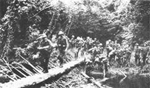
 Multimedia Object | 128th on trail to Buna
Format: jpg Image Dimensions: 640 x 376 Type: newspaper Note: Ray was a member of the 128th Infantry 32nd Division. This is a photo of the 128th on route to Buna taken a few days before Ray died. |
 |
Family with Parents - [View Family (F9353)] |


Research Assistant
| There are no research logs attached to this individual. |