|
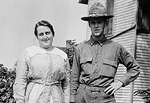
Surname: Wheat Given Names: Julie |
Gender: Female  |
Birth:
23 July 1895 -- Stept. Cty Il Death: January 1973 -- Freeport, Steph. Cty Il |
|
Hit Count:


Julie Wheat (I7538)
Hit Count:
|
|||||
  Events of close relatives Events of close relatives | |
| Birth | 23 July 1895  3432 Stept. Cty Il 3432 Stept. Cty Il |
| Death of father | 28 April 1930 (Age 34) John Dwight Wheat (I8011) (Age 69) |
| Marriage | September 1941 (Age 46) 1st Lt. Johann ''John'' Edward Donker Little Brown Church in the Vale, Nashua,Chickasaw County Iowa |
| Death of mother | 26 April 1949 (Age 53) Georgia A Bull-Edams (I43645) (Age 86) |
| Death | January 1973 (Age 77) Freeport, Steph. Cty Il |
| Universal Identifier | 5DE2F623CF89D511973400E02931A9519529 |
| Burial | City Cemetery, Freeport, Stephenson, IL |
| Last Change | 4 December 2006 - 11:50:08 Last changed by: dcoplien |
 Note |
Nurse Her niece Carol was adopted. She knew her brother and his wife wanted a child. The Dr. she worked for came to work one day with a baby in his black bag. She called her brother and he adopted the baby. It is not known who the babies real parents were. -- Little Brown Chruch - built by Valentine Haas The Little Brown Church located on Highway 346, North of Waterloo, Iowa. Just three miles from the Avenue of the Saints Highway, Exit 220 at Nashua. The first settlers came to the Bradford area in 1848 and with an abundant water supply and virgin timber, the town grew. By 1855 the first members of the Puritan-Congregational Church had begun holding meetings. By 1856, Bradford had 500 residents and was the first town in this part of Iowa. A young music teacher named William Pitts was traveling by stagecoach from Wisconsin to Iowa to visit his future wife. While waiting for the stagecoach horses to be changed, he walked down Cedar Street and saw the empty lot where the church now stands. Being a romantic young man, the thought came to him of what a charming setting the spot would make for a church. Returning home, he wrote the poem “Church in the Wildwood,” and later set it to music. He put it away in a drawer and forgot it. Meanwhile, church members grew tired of meeting in places such as the lawyer’s office, abandoned stores and parishioners’ homes. They began making plans to build a church. A family in the parish gave them the property. When Rev. Nutting arrived, talk of building became serious. Limestone was quarried and by 1860 the foundation was laid. The Civil War slowed the work, but when one family gave trees and another donated the sawing of the lumber, the work never really ceased. By 1862 the building was enclosed and not a penny had been spent. When it came time to paint the building, the cheapest paint to be found was Ohio Mineral Paint, which would protect the wood but which was unhappily brown. With help from friends in the east, the building was finished, complete with bell, in 1864. Mr. Pitts had married and was living in Wisconsin. In 1862 the couple moved to Fredericksburg to be near her elderly parents and Mr. Pitts was hired to teach singing class at the Bradford Academy. Imagine his surprise when he saw a little brown church nestled in the very trees where he had stood some years before. He went home and found the song and taught it to his class who sang it at the dedication service of the church. Pitts had written a song for a church that wasn’t there. The congregation had painted their little church brown without ever hearing of the song. History was hard on the Little Brown Church. The railroad by-passed the town and a flour mill moved to New Hampton to be on a bigger river. The railroad and other industry moved to Nashua. The town, once the county seat, slowly disappeared. In 1888, the church building was closed, although the congregation continued to hold Sunday School every week at the school. Occasional services were held at the building. In the early 1900’s a Society For The Preservation of The Little Brown Church was started and by 1914, services were again held, as they are now. History took another turn when the Weatherwax Quartet traveled throughout Canada and the United States in the 1920s and 30s. Their theme song was “The Church in the Wildwood” and they talked about the little church. After World War I, highways were improved and cars brought many visitors. When a School superintendent and a merchants’ daughter were married at the church, a new tradition was started. Over 40,000 visitors come to the Little Brown Church each year, and over 400 weddings are performed annually. In June of 2005, the 72,000 wedding was held at the church. The congregation is alive and well with an active Sunday School, youth groups, choirs, ladies’ fellowship, Bible study, a prayer chain group, and weekly services at 10:30 on Sunday. They remain, as they were founded, a Congregational Church, now affiliated with the United Church of Christ. The song continues to be sung in a little church that is painted brown and sits in the wildwood. In 1998 the bell tower was completely restored. In 2000 with help from the State Historical Society of Iowa Site Preservation Grant Program, a new foundation was placed under the church. This project has enabled the church to be completely handicap accessible. Air conditioning has been added for the first time. -- Valentine Haas was the oldest of six children. He was nicknamed ' 'Feldy' ' because of the felt hat he always wore. He was a farmer and a carpenter He married Hannah Cooper. They lived in Stephenson Co. Ill. 1857-1863, when they moved to Iowa where land was cheap. They lived in Chicashaw Co., Iowa from 1863 to early 1869 when they bought 40 acres along Stateline Rd., Tyrone, Wi. While in Iowa, Valentine helped to build the ' 'Little Brown Church in the Vale' ' Nashua, Iowa.This labor was all volunteer. Valentine and his brothers also built a number of the round barns in Southern WI and Northern IL |
 Multimedia Object | 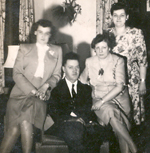 John and Julie (Wheat) Donker John and Julie (Wheat) Donker
Format: jpg Image Dimensions: 326 x 395 Type: photo 1st Lt. Johann ''John'' Edward Donker Note: Catherine, John, Julie, Jeanne |
 |
Family with Parents |
| Father |
|
|
| Mother |
|
|
| Brother |
|
|
| Brother |
|
|
| Sister |
|
|
| Brother |
|
|
| Brother |
|
|
 |
|
|
| Brother |
|
|
| Brother |
|
|
Family with 1st Lt. Johann ''John'' Edward Donker |
| Husband |
|
|
|
|
| There are no research logs attached to this individual. |