|
Given Names: Arthur James Surname: Howard |
Gender: Male  |
Birth:
23 November 1893 -- Brockley, London, England Death: 8 February 1917 -- WWI - Turkish POW camp, Mesopotamia (Iraq) |
|
Hit Count:

|
|
Arthur James Howard (I48323)
Hit Count:
|
|||||
  Events of close relatives Events of close relatives | |
| Birth | 23 November 1893 33 Brockley, London, England |
| Baptism | 13 January 1896 (Age 2) Lewisham St Mary,London, England |
| Death | 8 February 1917 (Age 23) WWI - Turkish POW camp, Mesopotamia (Iraq) |
| Universal Identifier | 2FF3A6BA7284498419EA6E12FD06C3DBB38C |
| Burial | Cemetery: Baghdad Gate, Mesopotamia (Iraq) |
| Last Change | 26 April 2011 - 15:49:21 Last changed by: dcoplien |
 Note |
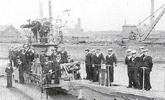
Rank: AB Birth Place: Brockley, London, England Branch of Service: Royal Navy Cause of Death: Died from disease Official Number Port Division: J.6684. (Po) Death Date: 8 Feb 1917 Ship or Unit: HM Submarine E20 Location of Grave: Not recorded Name and Address of Cemetery: Grave Unidentified. Commemorated On Special Memorial To Be Erected In Baghdad (North Gate) Relatives Notified and Address: Father: 124, Foxbury Rd, Brockley, London, SE -- E.20, submarine, lost 17 April 1915 HOWARD, Arthur J, Able Seaman, J 6684 (Po), Turkish POW, died in POW Camp, body relocated and buried at Baghdad Gate, Mesopotamia -- No Surname Rank Service Number Date Of Death Age Regiment/Service Nationality Grave/Memorial Ref. Cemetery/Memorial Name 1 HOWARD , A J Able Seaman J/6684 08/02/1917 24 Royal Navy United Kingdom Angora Mem. 88. BAGHDAD (NORTH GATE) WAR CEMETERY -- Cemetery: BAGHDAD (NORTH GATE) WAR CEMETERY Country: Iraq n 1914, Baghdad was the headquarters of the Turkish Army in Mesopotamia. It was the ultimate objective of the Indian Expeditionary Force 'D' and the goal of the force besieged and captured at Kut in 1916. The city finally fell in March 1917, but the position was not fully consolidated until the end of April. Nevertheless, it had by that time become the Expeditionary Force's advanced base, with two stationary hospitals and three casualty clearing stations. The North Gate Cemetery was begun In April 1917 and has been greatly enlarged since the end of the First World War by graves brought in from other burial grounds in Baghdad and northern Iraq, and from battlefields and cemeteries in Anatolia where Commonwealth prisoners of war were buried by the Turks. At present, 4,160 Commonwealth casualties of the First World War are commemorated by name in the cemetery, many of them on special memorials. Unidentified burials from this period number 2,729. The cemetery also contains the grave of Lieutenant General Sir Stanley Maude, Commander-in-Chief of the Mesopotamian Expeditionary Force, who died at Baghdad in November 1917 and the memorial to the 13th Division which he commanded. A memorial to the 6th Battalion Loyal (North Lancashire) Regiment was brought into the cemetery from the banks of the Diyala River in 1947. During the Second World War, Baghdad was again an objective of Commonwealth forces. The 20th Indian Infantry Brigade reached the city from Shaiba by the Euphrates route on 12 June 1941 and the 21st Indian Infantry Brigade, part of the 13th Duke of Connaught's Own Lancers, together with the 157th Field Regiment, Royal Artillery, arrived on 19 June via the Tigris. An advanced base was established later near the city and remained in use until 1946. Most of the 296 Commonwealth servicemen of the Second World War buried in the cemetery died of illness or by accident when serving with PAIFORCE. Again, a number of the graves were brought in from other burial grounds. Within the cemetery is the Baghdad (North Gate) (Khanaqin) Memorial, commemorating 104 Commonwealth servicemen, 437 Polish soldiers and 3 Arab Legionnaires of the Second World War buried in Khanaqin War Cemetery which, owing to difficulty of access, could not be properly maintained. The North Gate Cemetery also contains 127 war graves of other nationalities from both wars, 100 of them Turkish, and 41 non-war graves. == HMS E20 was a British E class submarine built by Vickers, Barrow-in-Furness. She was laid down on 25 November 1914 and was commissioned on 30 August 1915. Sunk by torpedo, 6 November 1916 (other sources 1915) While the German Submarine UB-14 had been in port on 30 November, Turkish forces had captured the French submarine Turquoise before the submarine or any of the confidential papers on board could be destroyed. When Turquoise was caught, her commander had not signaled her predicament to anyone, so a scheduled rendezvous with the British submarine E20—as far as anyone other than Turquoise or the Germans and Turks knew—was still on. UB-14 had been sent to keep the rendezvous, reportedly going so far as to radio messages in the latest British code. Upon arriving at the designated location, UB-14 surfaced and fired a torpedo at E20 from a distance of 500 metres (550 yd). Only when E20's crew saw the torpedo did they realize something was amiss, but it was too late to avoid the weapon. The torpedo hit E20's conning tower and sank the submarine with the loss of 21 men. UB-14 rescued nine men, including E20's captain who, reportedly, had been brushing his teeth at the time of the attack. Later E20 was raised by the Turks and renamed Mustejab Onbashy. (this fact is disputed) |
 |
Family with Parents |
| Father |
|
|
| Mother |
|
|
| Brother |
|
|
| Brother |
|
|
| Sibling |
|
|
 |
|
|
| Brother |
|
|
| Sister |
|
|
| Brother |
|
| There are no research logs attached to this individual. |

 38
38