Wanagapeth (I43361)
Hit Count:  
|
|
||||||||||||||||
|
|
|||||||||||||||||


Personal Facts and Details
  Events of close relatives Events of close relatives | |
| Birth | 1770  18 Miami Indian Territory 18 Miami Indian Territory |
| Marriage | 1805 (Age 35) Capt William Wells - [View Family (F18808)]
|
| Death | 1805 (Age 35) Kekionga (near what is now Fort Wayne Indiana) |
| Universal Identifier | 032E857EBA99C54A862E2D4AEA1F8526754C |
| Burial | prob. ancestral burial ground near what is now Fort Wayne IN |
| Last Change | 21 April 2007 - 08:57:47 Last changed by: dcoplien |
Notes
 Note |
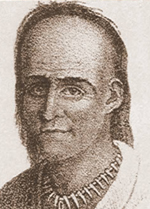
Daughter of Chief Little Turtle The Miami Indians originally lived in Indiana, Illinois, and southern Michigan. They moved into the Maumee Valley circa 1700. They soon became the most powerful Indian tribe in Ohio. The Miamis spoke one of the dialects of the Algonquian Indians and were thus related to the Delaware Indians, the Ottawa Indians, and the Shawnee Indians. The Miamis were allies of the French until British traders moved into the Ohio Country, circa 1740. The French forced the British out of Ohio, and the Miamis allied themselves with the French again until the British victory in the French and Indian War. As French trading posts turned into British forts, many Miami Indians moved to present-day Indiana to avoid further battles with the more powerful British. During the American Revolution, the Miamis, who were especially fearful of additional white settlers moving onto the natives’ land, fought with the British against the Americans. Little Turtle, also known as Michikinikwa (Me-she-kin-no-quah), was a war chief of the Miami Tribe, ca. 1790-1812. Little Turtle and Shawnee chief Tecumseh led the Miami and Shawnee people to resist white settlers in the western part of Ohio. They successfully defeated United States soldiers led by Josiah Harmar in October 1790 and soldiers led by Arthur St. Clair in 1791. An attack on Fort Recovery failed in 1794 and Little Turtle wanted to negotiate with the settlers. Other chiefs wanted to continue fighting. The Native Americans lost at the Battle of Fallen Timbers and in 1795 they signed the Treaty of Greene Ville ceding most of Ohio to the settlers. Little Turtle, hailed as the last Chief of the Miami Indians, was born in 1752 near Devil's Lake, northwest of Churubusco in Whitley County, Indiana. Little Turtle was the son of the Miami chief Acquenacke and a Mahican mother. Soon after his birth, his father moved the family to Ohio. As a young man, Little Turtle earned respect as a warrior for being brave in battle. Me-she-kin-no-quah later moved to the village of Ke-ki-ong-a. Kekinonga means blackberry patch. This was the Miami capitol, now known as Fort Wayne, Indiana. He led defeats of Gen. Josiah Harmar's and Gen. Arthur St. Clair's troops in the early 1790s. Little Turtle and his warriors were not beaten until 1793, when Gen. Anthony Wayne and his garrison routed the Miami at the battle of Fallen Timbers in August 1794. This defeat effectively put an end to two decades of warfare. The battle site is now a state park southwest of Toledo, Ohio. In 1795 Little Turtle signed the Treaty of Fort Greenville, ceding Indian lands in Ohio, Illinois, Indiana, and Michigan by a confederacy of Indians known as the Northwest Indian Confederation. The confederation included Miami, Chippewa, Iroquois, and others. Afterward, Little Turtle advocated peace and kept his people from joining Tecumseh's confederacy. Little Turtle also encouraged his people to abstain from alcohol, to develop new farming techniques, and to be vaccinated against smallpox. In later life, Michikinikwa continuously advised cooperation with the U.S., refusing an alliance with Tecumseh. He met cordially with George Washington ( Philadelphia in 1797.), who presented him with a ceremonial sword, as well as presidents John Adams and Thomas Jefferson. One story says that while on one of his journeys to Philadelphia, he met Col. Thaddeus Kosciusko, who presented him with a matching pair of pistols along with instructions to use them on the first person who tried to take his land. He retired to a spot near present-day Columbia City, Indiana, where he lived for almost three years. He died, in 1812, at the home of his son-in-law, Captain William Wells, not far from Kekionga, and was laid to rest in his ancestral burial ground. He was succeeded as chief of the Miami nation by Richardville (Peshewa). Little Turtle died on July 14, 1812 In 1911, a very old grave was accidentally discovered by a homebuilder on Lawton Place in Fort Wayne. Research showed that the tomb was indeed that of Michikinikwa. The sword given to him by George Washington was found in the grave and is now in the Ft. Wayne and Allen County Historical Society Musuem. The body was not disinterred, and the plans for the house were altered. A small memorial stone was placed there, which reads: This site honors the great Chief of the Miamis, Meshekinoqua, The Little Turtle, son of the great Chief Acquenacque. He is held in the hearts of his people, allies, and foes with the greatest of honor and respect for his courageous valor and peacemaking. In 1818, the United States forced the Miami Indians to give up their last reservation in Ohio. Most of these natives settled in Indiana, but the United States removed them to Kansas during the late 1820s. on a side note: Frances Slocum was a young girl who was "stolen by the Delaware Indians from her father's house near Wilkes-Barre, in Wyoming Valley, Luzerne county, Pa.," in September, 1778. My 5th Great Grandfather, Jacob Walters was one of the few white men that survived the attack. Frances was raised by the Miami living for while near Niagara, then near Detroit, then at Fort Wayne, and finally on the Mississenawa. |
Media
 Multimedia Object | 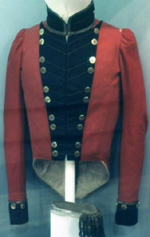 Capt. William Wells Coat Capt. William Wells Coat
Format: jpg Image Dimensions: 390 x 585 Type: photo Capt William Wells - [View Family (F18808)] |
 |
Family with Parents - [View Family (F18804)] |

|
Family with Capt William Wells - [View Family (F18808)] |
| Husband |
|
||
 |
|
||
| Daughter |
|

Research Assistant
| There are no research logs attached to this individual. |