 |
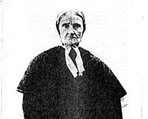
Sarah (Sally) Smith (I26247)
Hit Count:  
|
|
||||||||||||||
|
|
||||||||||||||||


Personal Facts and Details
  Events of close relatives Events of close relatives | |
| Birth | 19 October 1780  40 New Brunswick Nj 40 New Brunswick Nj |
| Death of mother | February 1781 (Age approx. 4 months) (unknown) Bogeart (I26599) - [Relationship Chart] |
| Marriage | 1796 (Age 16) Elias Derby - [View Family (F14008)]
Essex Nj |
| Marriage | 4 July 1801 (Age 20) Joshua R Randall - [View Family (F10367)]
New York City, New York |
| Divorce | Joshua R Randall - [View Family (F10367)]
|
| Death of father | 9 October 1807 (Age 26) Jeremiah Smith (I26252) (Age 67) - [Relationship Chart] |
| Death | 4 March 1865 (Age 84) Laona, Winnebago, Illinois |
| Universal Identifier | 5532E49E5FE8204CB06DD4590A23E2F2078B |
| Burial | Laona, Winnebago, Illinois |
| Last Change | 3 December 2006 - 08:21:13 Last changed by: dcoplien |
Notes
 Note |
Dutch Family were among first settlers of New Amsterdam, now Manhattan NY if her birth records are in Dutch, name would be: Sarah/Sally -- Saartje, Seer, Sasze, Taatje, Selitje 1750 - Laona, Winnebago, IL with daughter Sarah 1860 - Illinois Effingham Township 8 N Range 5 E ??? Youngest of 8 children Her mother died when she was about 4 Her first husband was lost at sea. His name may have been Elias Derby Her husband had several children by other women, then left Sarah by 1830 1839 - to Leona, Winnebago IL Father From Somerset County Historical Quarterly Vol VII SMITH, JEREMIAH, of Rocky Hill. Dated May 7, 1782. Recorded but not probat. Names sons--Joseph, Samuel, Gabriel and John J.; daus. Abigail, Mary, Elizabeth and Sarah. Executors: friends John Rule and Samuel Smith. Witnesses: John Berrian, Martin Armstrong, Nehemiah Smith -- New Amsterdam (Dutch: Nieuw Amsterdam) was the name of the 17th century town which grew outside of Fort Amsterdam on Manhattan Island in the New Netherland territory (1614–1674) which was situated between 38 and 42 degrees latitude as a provincial extension of the Dutch Republic since 1624. The province's first settlement was established on Governors Island in 1624 from where Fort Amsterdam was commenced in 1625. Earlier, the harbor and the river had been discovered, explored and charted by an expedition of the Dutch East India Company captained by Henry Hudson in 1609. Subsequently, the territory was surveyed and charted by various private commercial companies on behalf of the States General of the Dutch Republic prior to taking possession as an overseas province in 1624. The town of New Amsterdam became a city when it received municipal rights in 1653 and was unilaterally reincorporated as New York City in June 1665. The town was founded by New Netherland's second director, Willem Verhulst who, together with his council, selected Manhattan Island as the optimal place for permanent settlement in 1625. They quickly began establishing businesses there, among which was the first brewery in North America.[citation needed] That year, military engineer and surveyor Cryn Fredericksz van Lobbrecht laid out a citadel with Fort Amsterdam as centerpiece. To secure the settlers' property and its surroundings according to Dutch law, Peter Minuit created a deed with the Manahatta Indians in 1626 thus ensuring legal possession of Manhattan. The city, situated on the strategic, fortifiable southern tip of the island of Manhattan was to maintain New Netherland's provincial integrity by defending river access to the company's fur trade operations in the North River, later named Hudson River. Furthermore, it was entrusted to safeguard the West India Company's exclusive access to New Netherland's other two estuaries; the Delaware River and the Connecticut River. New Amsterdam developed into the largest Dutch colonial settlement in the New Netherland province, now the New York Tri-State region, and remained a Dutch possession until August 1664, when it fell provisionally into the hands of the English. The Dutch Republic regained it in August 1673 with a fleet of 21 ships, renaming the city "New Orange". New Netherland was ceded permanently to the English in November 1674 in the Treaty of Westminster. The 1625 date of the founding of New Amsterdam is now commemorated in the Official Seal of the City of New York (formerly, the year on the seal was 1664, the year of the provisional Articles of Transfer, ensuring freedom of religion, negotiated with the English by Petrus Stuyvesant and his council). Early Settlement (1609–1625) The first recorded exploration by the Dutch of the area around what is now called New York Bay was in 1609 with the voyage of the ship Halve Maen or Half Moon, captained by Henry Hudson, in the service of the Dutch Republic, as the emissary of Holland's Lord-Lieutenant Maurits. Hudson named the river the Mauritius River and was covertly attempting to find the Northwest Passage for the Dutch East India Company. Instead, he brought back news about the possibility of exploitation of beaver pelts in the area, leading to private commercial interest by the Dutch who sent commercial, private missions to the area the following years. At the time, beaver pelts were highly prized in Europe, because the fur could be "felted" to make waterproof hats. A by-product of the trade in beaver pelts was castoreum — the secretion of the animals' anal glands — which was used for its supposed medicinal properties. The expeditions by Adriaen Block and Hendrick Christiansz in the years 1611, 1612, 1613 and 1614 resulted in the surveying and charting of the region from the 38th parallel to the 45th parallel. On their 1614 map, which gave them a four year trade monopoly under a patent of the States General, they named the newly discovered and mapped territory New Netherland for the first time. It also showed the first year-round, top-of-the-Hudson River, island-based trading presence in New Netherland, Fort Nassau, which 10 years later, in 1624, would be replaced by Fort Orange on the main land which grew into the town of Beverwyck, now Albany. The territory of New Netherland, comprising the Northeast's largest rivers with access to the beaver trade, was provisionally a private, profit-making commercial enterprise focusing on cementing alliances and conducting trade with the diverse Indian tribes. They enabled the serendipitous surveying and exploration of the region as a prelude to anticipated official settlement by the Dutch Republic which occurred in 1624. Immediately after the armistice period between the Dutch Republic and Spain (1609–1621) the founding of the Dutch West India Company took place in 1621. That year, as well as in 1622 and 1623, orders were given to the private, commercial traders to vacate the territory thus opening up the territory to the transplantation of Dutch culture onto the North American continent whereon the laws and ordinances of the states of Holland would now apply. Previously, during the private, commercial period, only the law of the ship had applied. The mouth of the Hudson River was selected as the most perfect place for initial settlement as it had easy access to the ocean while securing an ice free lifeline to the beaver-rich, unexploited forests farther north where the company's traders could be in close contact with the American Indian hunters who supplied them with pelts in exchange for European-made trade goods for barter and wampum, which was soon being "minted" under Dutch auspices on Long Island. Thus in 1624 when the first group of families arrived on Governors Island to be followed by the second group of settlers to the island in 1625, in order to take possession of the New Netherland territory and to operate various trading posts, they were spread out to Verhulsten Island (Burlington Island) in the South River (Delaware River), to Kievitshoek (now Seabrook) at the mouth of the Verse River (Connecticut River) and at the top of the Mauritius or North River (Hudson River), now Albany. Fort Amsterdam (1625) The potential threat of attack from other interloping European colonial powers prompted the Directors of the Dutch West India Company to formulate a plan to protect the entrance to the Hudson River, and to consolidate the trading operations and the bulk of the settlers into the vicinity of a new fort. In 1625, most of the cattle and some settlers were moved from Noten Eylant, since 1784 named Governors Island, to Manhattan Island where a citadel to contain Fort Amsterdam was being laid out by Cryn Frederickz van Lobbrecht at the direction of Willem Verhulst who had been empowered by the Dutch West India Company to make that decision in his and his council's best judgment. For the location of the fort, company director Willem Verhulst and Military Engineer and Surveyor Cryn Fredericks chose a site just above the southern tip of Manhattan. The new fortification was to be called Fort Amsterdam. By the end of the year 1625, the site had been staked out directly south of Bowling Green on the site of the present U.S. Custom House; west of the fort's site, later landfill has now created Battery Park. 1625–1674 New Amsterdam around 1650 Dutch Governor Stuyvesant greets a Hackensack Indian delegation 1660. New Amsterdam c. 1674Willem Verhulst, with his council responsible for the selection of Manhattan as permanent place of settlement and situating Fort Amsterdam, was replaced by Peter Minuit in 1626. To legally safeguard the settlers' investments, possessions and farms on Manhattan island, Minuit negotiated the "purchase" of Manhattan from the Manahatta Indians for 60 guilders worth of trade goods. The deed itself has not survived so the conditions causing the negotiation and validation of the deed are unknown. A textual reference to the deed became a foundation for the legend that Minuit had "purchased Manhattan from the Native Americans for 24 dollars worth of trinkets." The Manahattas had no legal concept of permanent ownership of land since they moved encampments on a seasonal basis and lived off whatever land they inhabited. Since the Manahattas were not familiar with European legal issues they could not have understood the concept of property deeds or the rule of law. We therefore don't know what they thought they relinquished for signing the deeds other than what they physically received for doing so. While the originally designed large fort, meant to contain the population as in a fortified city, was being constructed, the Mohawk–Mahican War at the top of the Hudson led the company to relocate the settlers from there to the vicinity of the new Fort Amsterdam. As the settlers were at peace with the Manahatta Indians, the fact that no large scale foreign powers were imminently trying to seize the territory, and that colonizing was a prohibitively expensive undertaking, only partly subsidized by the fur trade, led a scaling back of the original plans. By 1628, a smaller fort was constructed with walls containing a mixture of clay and sand, like in Holland. See also Wall Street. Upon first settlement on Noten Eylant Governors Island in 1624, a fort and sawmill was built. The latter was constructed by Franchoys Fezard. The new settlement had a population of approximately 270 people, including infants. A pen-and-ink view of New Amsterdam, drawn on-the-spot and discovered in the map collection of the Austrian National Library of Vienna in 1991, provides a unique view of Nieuw Amsterdam as it appeared from Capske (small Cape) Rock in 1648. Capske Rock was situated in the water close to Manhattan between Manhattan and Noten Eylant, now Governors Island, which signaled the start of the East River roadstead. New Amsterdam received municipal rights on February 2, 1653 thus becoming a city. On August 22, 1654, the first Ashkenazic Jews arrived with West India Company passports from Amsterdam to be followed in September by a sizable group of Sephardic Jews, without passports, fleeing from the Portuguese reconquest of Dutch possessions in Brazil. The legal-cultural foundation of toleration as the basis for plurality in New Amsterdam superseded matters of personal intolerance or individual bigotry. Hence, and in spite of certain persons private objections, the Sephardim were granted permanent residency on the basis of "reason and equity" in 1655. Nieuw Haarlem was formally recognized in 1658. New Netherland was provisionally ceded by director-general Peter Stuyvesant to the English in a surprise incursion on September 24, 1664 when the two European nations were at peace. This resulted in the Second Anglo-Dutch War, between England and the United Netherlands. In 1667, the Dutch did not press their claims on New Netherland (but did not relinquish them either) in the Treaty of Breda, in return for an exchange with the tiny Island of Run in North Maluku, rich in nutmegs and the guarantee for the factual possession of Suriname, that year captured by them. The New Amsterdam city was subsequently renamed New York, after the Duke of York (later King James II) — brother of the English King Charles II — who had been granted the lands with the kingly stroke of an armchair pen (similar to the Spanish claim to the entire western hemisphere). However, in the Third Anglo-Dutch War, the Dutch recaptured New Netherland in August 1673 and Anthony Colve was named Governor, and the city was renamed "New Orange". After the signing of the Treaty of Westminster in 1674 the city was relinquished to British rule and the name reverted to "New York"; Suriname became official Dutch property in exchange. Visible traces of Dutch influence include the prevalence of Dutch placenames in the New York Tri-state area to this day. Examples include Cape Henlopen, Cape May, Kinderhook, Catskill, Claverack, Block Island, Hoboken, Lange Eylant (Long Island), Breuckelen (Brooklyn), Harlem, Amsterdam, Rotterdam, The Bronx, Konynen Island (Coney Island), Staten Eylant (Staten Island), Hell Gate (Hellegat), Oyster Bay, Tappan Zee and others, including many roads and establishments. In addition, many New York citizens are directly descended from the Dutch citizens of New Netherland. For instance, the Roosevelt family, which produced two Presidents, are descended from Claes van Roosevelt, who emigrated from Haarlem in about 1650. The Van Buren family of President Martin Van Buren also originated in New Netherland. The folk tales of the Dutch peasants of the Hudson Valley gave literary inspiration to Washington Irving for his two most famous short stories, Rip van Winkle and the Legend of Sleepy Hollow, proving the survival of the local Dutch culture well until the first part of the 19th century |
 |
Family with Parents - [View Family (F10368)] |

|
Family with Elias Derby - [View Family (F14008)] |
| Husband |
|
||
 |
|
|
Family with Joshua R Randall - [View Family (F10367)] |
| Ex-Husband |
|
||
|
|
||
| Son |
|
||
| Daughter |
|
||
| Son |
|
||
| Son |
|
||
| Daughter |
|
||
| Son |
|
||
| Daughter |
|
||
| Daughter |
|
||
| Daughter |
|
||
| Daughter |
|
Research Assistant
| There are no research logs attached to this individual. |