Anmerkung |
Spouse: Conrad POPE
...was born to Philipp Bopp (Bobb), a man of the court of Frankenstein and his married house woman...
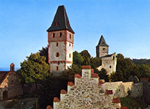
Literally, in German, the name Frankenstein means stone of the Franks. Frankenstein is the former name of Ząbkowice Śląskie, a city in Silesia. There is a town called Frankenstein in the palatinate with Burg Frankenstein (Frankenstein Castle) and Burg Frankenstein near Darmstadt. Moreover Frankenstein is a common family name in Germany.....yes, it is THAT Frankenstein Castle.Mary Shelley, author of Frankenstein is said to have stayed at the castle not long before she wrote her book.
The castle's most notorious inhabitant, according to Clairmont, was Johann Conrad Dippel, a physician and theologian. Dippel had attempted to construct a new human being out of body parts, virginal blood and esoteric, magical rites. Dippel used the castle's prison as a laboratory to conduct alchemistic experiments, which included attempts to create gold for the Count of Hesse.
Legend:
Frankenstein Castle situated along the Rhine-Main district, is a sight to behold. Full of history & stories. This is where the legend of Sir George von Frankenstein unfolds. There was a dragon terrorizing the town, & only the fairest of maidens could be sacrificed to persuade the dragon to return to the brook in the Katzenborn. The ranger's daughter, Annemarie, known as the "Rose of the Valley", would be sacrificed. Sir George, just returning from a war went out at dawn well-armed to face the dragon & rescue his secret love. After a long fight he rendered a deadly blow to the beast. The monster grabbed the knight's left leg, & in a dying effort injected poison into the bend of his knee & mortally wounding him.
--- The Frankenhousers---- (some of these dates to not match the official records but this appears to come from one man's memory)
Anabaptist hide-out in Fankhaus near Trub, Switzerland
from http://home.tele2.ch/beeler/taeuferversteck.htm
Far away from a larger town, a small nature path at the foot of the Napf mountain leads us to the "Hinter-Hütten" farm in Fankhaus. On the beam over the entrance door the numbers 1608 have been crudely carved; it is the year the farmhouse was built. Using a side entrance we enter the hay floor where the entry to the Anabaptist hide-out can be found. It seems it is the only one still existing in the Emmental and possibly in the whole of Switzerland. Many similar places of asylum were destroyed by remodelings.
The late owner of the farm, Hans Fankhauser, was able to tell the following details:
"From generation to generation it was also reported that when they wanted to go get the Anabaptists, they just saw them jump over the entrance, into the barn and vanish. They simply didn't find anything anywhere in the whole house. Then they had the idea that they could hide one of their agents at the barn entrance to see where they went. And they did it this way. When the Anabaptist came running to the entrance, the agent saw that the man jumped on a wooden board that tilted, he slid into the hide-out and the board tilted back to its original position. That is how they could just disappear without being found."
....This refuge place is a quiet witness to Christians which lived with total dedication for Jesus Christ. Who sheltered an Anabaptist in those days or even provided refuge for an Anabaptist teacher, had to pay fines which today would amount to several thousand Swiss francs - truly a courage for ones beliefs which put us to shame.
From various documents we know pretty accurately when Anabaptists lived in this farm.
From the marriage of Peter Fankhauser, Great Grandfather to Eva Maria (1625 - 1679) and Catharina Wüthrich(married in 1650), were eleven children.
Two of them joined the Anabaptists:
Luceya (born 1659), which the Anabaptist Hans Habegger from Unterscharzentrub married and Christen (1668 - ?) who married Barbara Habegger (born around 1670 and died 1721) in 1689. Her parents were Niklaus Habegger (from Höchstalden, Trub) and Barbara Rentsch (from Trub). Hans Habegger, the husband of Luceya, could have been the brother of Barbara. Three children were born to this couple: Peterli (1690 -1692), Johannes (1692 - ?) and Peter Fankhauser (1698 -1750).
In 1691 Christen was threatened with bankruptcy. His savings were confiscated. Evidently he did not let himself be led astray by the machinations of the government or the church. He was tossed into prison in Bern in January, 1709, where he was held for over 14 months. According to the reports of other prisoners, the conditions in the prison were ghastly.
The Bernese governement planned to deport the men and women who had been imprisoned for their beliefs to Pennsylvania (America). On March 18th, 1710, 45 men and 12 women were put into boats in Bern "without a penny to have on their way", as Melchior Zahler, one of the prisoners, reported. Already at Mannheim on the 28th of March, one had to permit 32 fairly sick people to go ashore. Christen Fankhauser belonged to that group. The other 22 persons were set free on the 9th of April in Nimwegen, which angered the Bernese government. The Dutch government foiled the deportation in the name of religious freedom.
In the meantime, the life on the farm continued. It was operated by the youngest unmarried brother of Christen whereby the confiscated "part of Christen amounting to 675 pounds, which the rulers had taken ... had to be industriously paid off."
It seems the wife of Christen Fankhauser went to be with her husband; she died in 1721(1731) either in the Palatinate [region of Germany] or in Holland. Thus the youngest son Peter became the sole heir of the Hinter-Hutten farm. According to a notation in the marriage records, he was also an Anabaptist at first. In 1740, from "my highly esteemed lords of the Anabaptist Cabinet he was graciously given and bequeathed the sum of 614 pounds which derived from his dead Anabaptist father Christen Fanckhausser."
Like his father, Johannes also could not reconcile himself with the state church and its ways. He marred Barbara Habegger (born in 1694), a daughter of his uncle Hans Habegger and his aunt Luceya Fankhauser (the date and place are unknown). In 1711 he moved to the Palatinate, where his father was staying. Later he traveled on to Holland. The couple was blessed with three sons: Johannes (around 1715 - 1765), Jakob (1717 - 1771) and Christian Fankhauser ( around 1719 - ?). In 1728 the whole family got onto the Mortenhouse ship in Rotterdam with many other emigrants in order to go to Philadelphia. After that, they settled in Virginia. Today one can find numerous descendents of these religious refugees from Switzerland in the USA
|


 Verwandtschafts-Ereignisse
 34
34