 |
Reinder J Donker (I14906)
Hit Count:  
|
|
||||||||||||||
|
|
||||||||||||||||

Personal Facts and Details
  Events of close relatives Events of close relatives | |
| Birth | 12 April 1839  32 32 23 Hanover,, Prussia 23 Hanover,, Prussia |
| Marriage | 9 December 1875 (Age 36) Margaretha Wille - [View Family (F2134)]
Stephenson County Il |
| Marriage | 24 January 1884 (Age 44) Gertruda A Kruse - [View Family (F2323)]
Stephenson, Il |
| Death of mother | 11 September 1894 (Age 55) Antje F Sweer (I5003) (Age 78) - [Relationship Chart] |
| Death | 15 May 1917 (Age 78) |
| Burial | 16 May 1917 Lane Cemetary,Florence Station, Steph. Cty Il |
| Universal Identifier | 629F16295FC1D511973400E02931A95145C2 |
| Last Change | 29 April 2011 - 05:57:17 Last changed by: dcoplien |
Notes
 Note |
birth 12 Apr 1839;1839 —Germany death 15 May 1917 —Florence Station, Florence Township, Stephenson, Illinois burial 18 May 1917 parents: John Donker, Antje Sweede record title: Illinois, Deaths and Stillbirths, 1916-1947 name: Reinder Donker death date: 15 May 1917 death place: Florence Station, Florence Township, Stephenson, Illinois gender: Male age: 78 estimated birth year: 1839 birth date: 12 Apr 1839 birthplace: Germany father: John Donker mother: Antje Sweede occupation: Shoemaker, Gen.Repair burial date: 18 May 1917 cemetery: Florance Cemetery digital folder number: 4007998 volume/page/certificate number: 40 1880 mother and 2 brother in Shannon, Carroll, IL - he was married in 1875 in Ogle County IL as I suspected, I think the family allowed another family to use their papers to come to America Home in 1880: Florence as Konder Donker, listed as a widower even though his wife Margaretha is alive and on the census - appears the son that died in MI (assumed Eiko) was his step-son Eiko however since Reinder check the box for widower, he may have had a son from a previous marriage. It's also possible and more likely that the box should have been marked for Margaretha as she was a widow when they married and Gertruda is actually Gertruda Kruse. The 1880 death index shows Margaretha died Dec 1880 however that came out in the summer of 1880. Her death cert. says 1879. Since she does appaer on the 1880 census and her headstone has no dates, we will never know for sure. It is possible that Reinder added her name, then marked himself as a widow. place of birth per 1920 census (children father POB) came to IL 1873 - per 1910 census, 1872 Gertruda is a half sister to Fannie and Antjie John #1 and Margaretha. Fannie and Antjie are by Reinder's first marriage to the widow Kruse. Gertruda is his first wife's (Margareta) daughter by her first marriage Cobbler. Lived first in or near Bailyville, Ogle IL, then Florence Station, Stephenson IL The area Jon Jans Donker would have come from was known as Friesland which was west of OstFriesland, "Ost" meaning "east". At the beginning of the 19th century, many Donkers are living in and around Sint Jacobiparochie Gemeente Het Bildt Friesland. It was part of the Netherlands which explains the Dutch name in a family that was very proud to be German. If Jon Jans came from the Donker line of Workum, Friesland, the true family name, in a sense is Van Der Veer. When Hendrik Pieters Van Der Veer married Aaltje Jacobs De Vries (daughter of Jacob Vries) of Sneek Friesland, he took the surname Donker. His Grandfather took the name surname Christiaans durng the period known as the Enlightenment, his father did not. This is a period when many Jews of Europe became Christians. Van Der Veer means the son of Veer and in some cases, spouse of Veer. (Chrtiaans (yes 2 "a"'s and and s). Records for his sons births refer to him as Van Der Veer which probably relates to his wife. His sons records show they went by De Vries. If Chrtiaans wife remained Jewish, and the children were Jewish, they would refer to themselves in relationship to their Jewish mother, not their Christian father. The name Donker can mean a man of dark complextion and/or hair, or a man that lived on or near a small hill. Hanover Germany Hanover (German: Hannover) is a historical territory in today's Germany. Hanover was an independent kingdom from 1814 to 1866 and a province of Prussia from 1866 to 1946. Many immigrants born in Hanover when it was an independant kingdom noted on their census forms that they were from Hanover, not Germany. This is the case with Reinder and Gertrutruda's father Johann. Hanover was originally called the Principality of Calenberg, which was a subdivision of the Duchy of Brunswick-Lüneburg. The Principality of Calenberg existed from 1432 until 1803. Hanover is named after its capital, Hanover. The Duchy of Brunswick-Lüneburg, a state of the Holy Roman Empire, was frequently subdivided into different principalities, each of which was ruled by a duke; one of these was the Principality of Calenberg. It was first created when it was split off from the Principality of Brunswick in 1432. It fell to the Principality of Wolfenbüttel in 1584. In 1635 it was separated again from Wolfenbüttel, together with the Principality of Göttingen, with which it would stay joined. In 1636, the capital of the Principality of Calenberg was moved from Pattensen to Hanover, and hence it also became known as Hanover. In 1692, Duke Ernest Augustus received the additional title of prince-elector. The principality was then also known as the Electorate of Brunswick-Lüneburg or, informally, the Electorate of Hanover. In 1714, the Hanoverian electors became kings of Great Britain (see House of Hanover). The influence of the electors in Germany grew also: they inherited the Principality of Lüneburg in 1705, and the formerly Swedish territories of Bremen and Verden in 1719. As part of the German Mediatisation of 1803, the Electorate received the Bishopric of Osnabrück. In 1803, the Electorate was occupied by France, which ruled over it in some form or another for the next ten years. From 1807 on, the Hanoverian territority was part of the Kingdom of Westphalia. In 1813, the Electorate was restored, and in October of 1814 it became the Kingdom of Hanover at the Congress of Vienna, in order to make George III equal to the upstart King of Württemberg in German affairs. The Congress of Vienna installed a territorial exchange between Hanover and Prussia, in which Hanover increased its area substantially. Hanover gained the Bishopric of Hildesheim, East Frisia, the Lower County of Lingen, and the northern part of the Bishopric of Münster. It lost those parts of the Duchy of Lauenburg to the right of the Elbe, and several small exclaves in the east. The personal union with the United Kingdom ended in 1837 on the accession of Queen Victoria because the succession laws (Salic Law) in Hanover prevented a female inheriting the title if there was any surviving male heir (in the United Kingdom, a male only took precedence of his own sisters). In the Austro-Prussian War of 1866, Hanover was annexed by Prussia and became the Province of Hanover. During the Austro-Prussian war boys could be drafted at the age of ten. This caused many families to immigrate to America. Florence Station It is known as an Ostfriesland settlement; Ostfriesland is an area in Northern Germany and what is now part of the Netherlands. (There are many Donkers in Holland and the Netherlands, Reinders father's names was Jon Jans, the Dutch variation of Johann). The people who emigrated from Ostfriesland tended to form their own settlements. Most came by ship through Bremen. The first settled in the 1830s, but the first village was not set up until 1859 when the train came through. (Hence the name Florence Station.) Some of the earliest settlers (before the village was set up) included the Gronewolds (some other spellings also exist.) In 1872, a George Denker emigrated there; he had been born in Folken, Ostfriesland 3/17/1823. It is not clear if he lived in the village or close to it. In 1900 George is living with his grand-daughter Etta Manson in Orvil, Logan, Illinois. During the Civil War, the Illinois 99th Regiment Infantry was mustered in Florence Station (Aug. 62) and were discharged here in 1865 after losing more than 100 men, most to illness. In the Illinois Atlas, Florence Station is listed as having a Post Office, RR station, and ' 'Express.' ' The population is not listed, although other towns of less than 100 have the population listed. ( I suspect it was quite small.) There is one cemetery there, generally known as the Lane cemetery. This is where many of the first generation of American Donkers are buied. I believe George Denker was related to Reinder. The Gronewold's married several of Reinders nieces and nephews. They were related to the Kruse's before coming to America as were the Bushkohls. IL death index: DONKER, PETER 11/13/1910 BAILEYVILLE 77 YR M 4 35 3506 OGLE born about 1833 ??? Possibly related to George Denker DONKER GERTRUDE F/W UNK 0890074 1933-06-15 STEPHENSON FLORENCE TWP 1933-06-15 DONKER HELEN MARY F/W UNK 0000087 1940-02-29 STEPHENSON FREEPORT - - DONKER REINDER M/W UNK 0040231 1917-05-15 STEPHENSON FLORANCE 1917-05-16 IL marriage index DONKER, JOHN EDWARD, HOWARD, HELEN MARY 08/21/1917 / 677 STEPHENSON DONKER, REINDER KRUSE, GERTRUDE A 01/24/1884 / 340 STEPHENSON DONKER, REINHART, WAGENS, ALZINA 02/29/1912 / 888 STEPHENSON |
Media
 Multimedia Object | 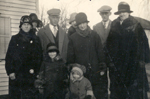 Gertruda (Kruse) Donker and family Gertruda (Kruse) Donker and family
Format: jpg Image Dimensions: 686 x 492 Type: photo Gertruda A Kruse - [View Family (F2323)] Note: from left to right 1st row: Jeanne Donker, Catherine Donker 2nd row: Gertrude (Kruse) Donker, Paul, Becky, Fannie 3rd row: Meta, Becky, Ferdinand |
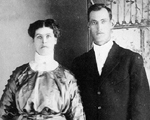
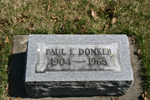
Multimedia Object | 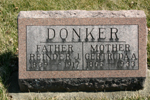 Reinder and Gertruda (Kruse) Donker Reinder and Gertruda (Kruse) Donker
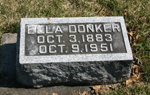
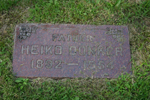
Format: jpg Image Dimensions: 650 x 433 Type: tombstone Gertruda A Kruse - [View Family (F2323)] |
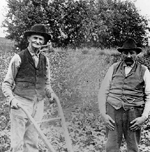
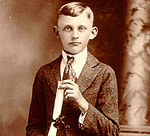
Multimedia Object | Donker Brothers
Format: jpg Image Dimensions: 385 x 577 Type: photo Note: left Reinder, right Paul |
 |
Family with Parents - [View Family (F834)] |

|
Family with Margaretha Wille - [View Family (F2134)] |
 |
|
||
| Wife |
|
||
| Daughter |
|
||
| Daughter |
|
||
| Son |
|
||
| Daughter |
|
|
Family with Gertruda A Kruse - [View Family (F2323)] |
|
|
||
| Wife |
|
||
| Daughter |
|
||
| Son |
|
||
| Daughter |
|
||
| Son |
|
||
| Son |
|
||
| Daughter |
|
||
| Daughter |
|
||
| Son |
|
||
| Son |
|
Research Assistant
| There are no research logs attached to this individual. |